
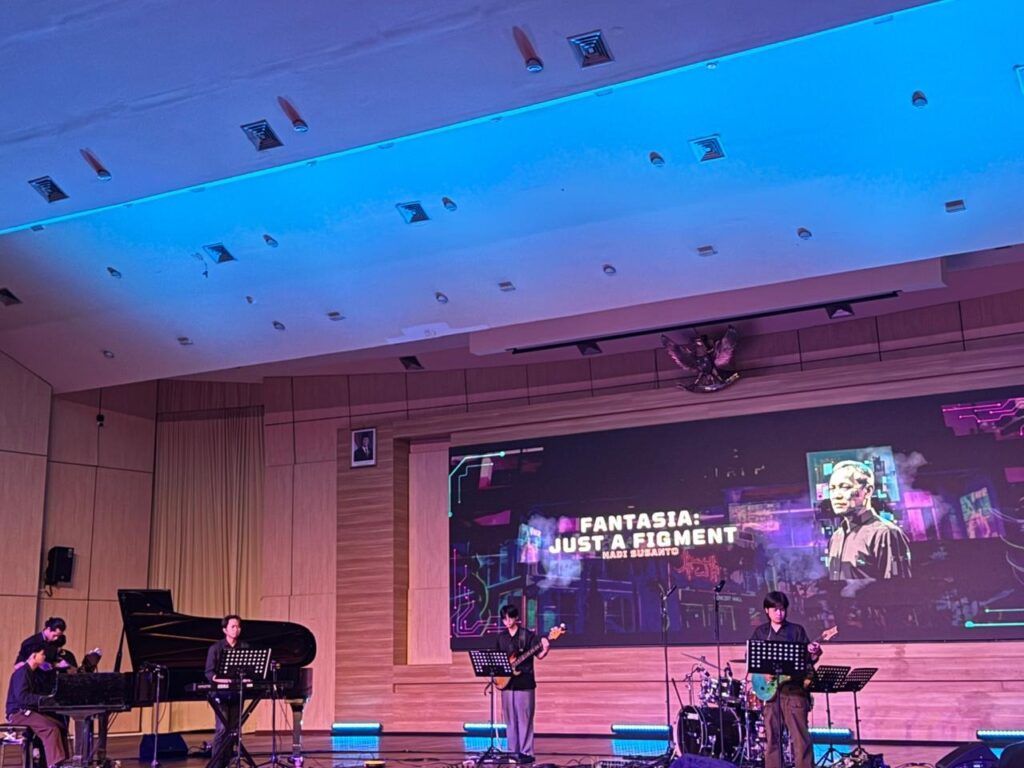
YOGYAKARTA, May 13, 2026 – In celebration of the 42nd anniversary of the Indonesian Institute of the Arts (ISI) Yogyakarta, the Music Composition Program launched an ambitious art project titled “SONUS MOVENTES #1.” Held at the ISI Yogyakarta Concert Hall, this event is not merely a standard performance stage but a space for in-depth discourse and experimentation centered on the theme “Music That Challenges.” This initiative also serves as proof that the power of human creativity remains strong and resilient amidst the current onslaught of Artificial Intelligence (AI) technology.
Breaking Boundaries Through Nomadic Aesthetics.
Chief Executive Officer, Harly Yoga Pradana, S.Sn., M.Sn., revealed that the choice of the name “Sonus Moventes,” meaning sound that moves or moves others, carries a highly strategic vision for the institution. This project is projected to become the driving force that propels the university's academic music creations onto the global stage. In this inaugural edition, all composers have agreed to respond to the theme of “Nomadic Aesthetics,” an idea rooted in the philosophical thought of Gilles Deleuze. This concept challenges artists to break free from static and established musical structures (state), guiding their works toward a state of becoming—a continuous process of consciousness that transcends conventional cultural and technical boundaries.
Unlike the formats of previous years dominated by lecturers, this event marks a new milestone by actively involving students as composers. This intergenerational synergy was realized thanks to strong collaboration between the academic community, Kompazz (Music Creator Community), KKM (Student Creativity Group), and technical support from ArsLab.
Explore 14 Innovative Works
From a total of 14 curated works, the composers presented a variety of fresh and bold approaches. Budhi Ngurah, through “Grand Duo No. 2,” blended Slendro and Pelog pentatonic idioms with explorations of violin and a band combo. Meanwhile, Ramya Shafiqa S.B., in “Misaligned Dialogue,” utilized aleatoric procedures with the aid of dice to represent cognitive chaos and the fragmentation of human communication.
The dismantling of traditional structures is also presented in Adi Wijaya's work “Hinge,” which emphasizes egalitarian collective improvisation. A nomadic spirit is also strongly felt in the work “Titik-Titik,” which boldly deconstructs established Keroncong music conventions. Not to be outdone, a technology-based approach is present in “Unfolding Order I,” a composition that utilizes Cellular Automata algorithms to distribute spectral harmonies.


 EN
EN  ID
ID